
You get out of the car after a long drive and need a few steps before you're fully upright. You bend to load the dishwasher after a day at the desk and your back lets you know about it.
Most of the explanation sits in your hips, which is where a lot of lower back stiffness starts.
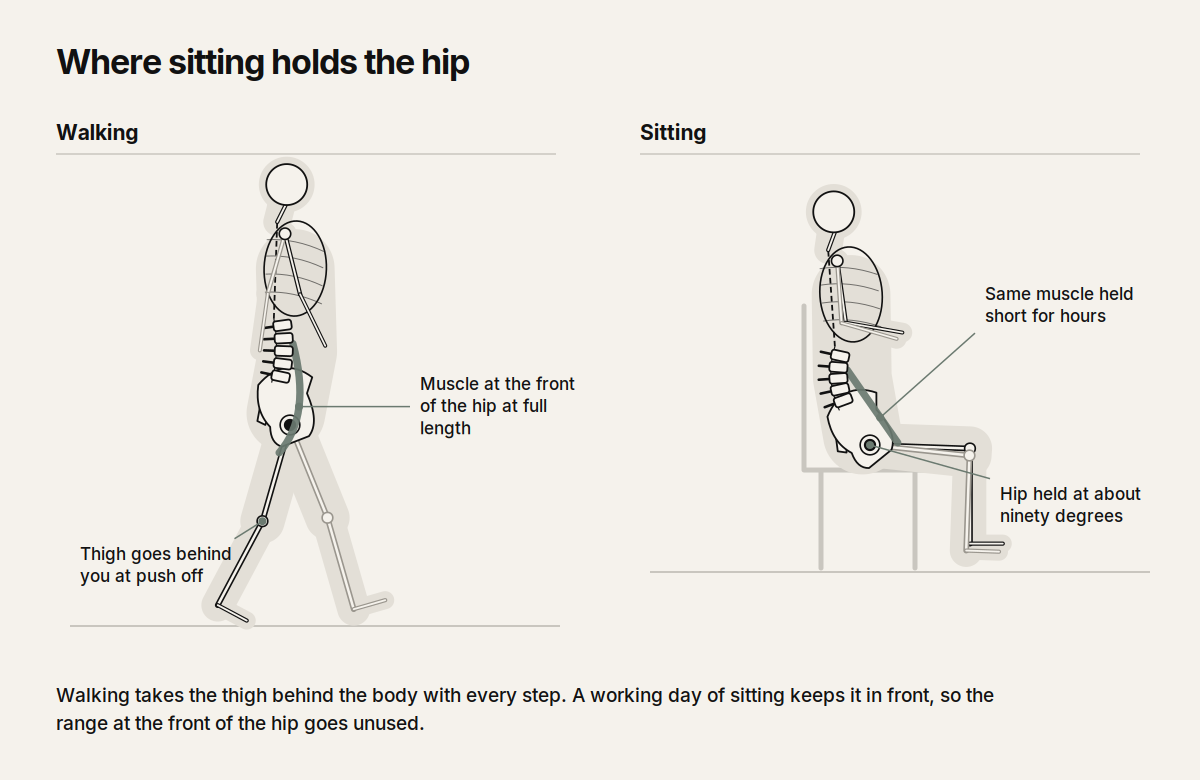
Your lower back is built to move a moderate amount in every direction. Your hips are built to move a lot, especially forwards and backwards. Standing, walking and bending share the work between them. Sitting holds your hips at roughly ninety degrees of bend for hours, and the range at the front of the hip, the range you use to stand fully upright and to push off when you walk, goes unused. Tissue held at one length for long periods adapts to that length, and the nervous system stops maintaining control at the end of a range when nothing asks for it.
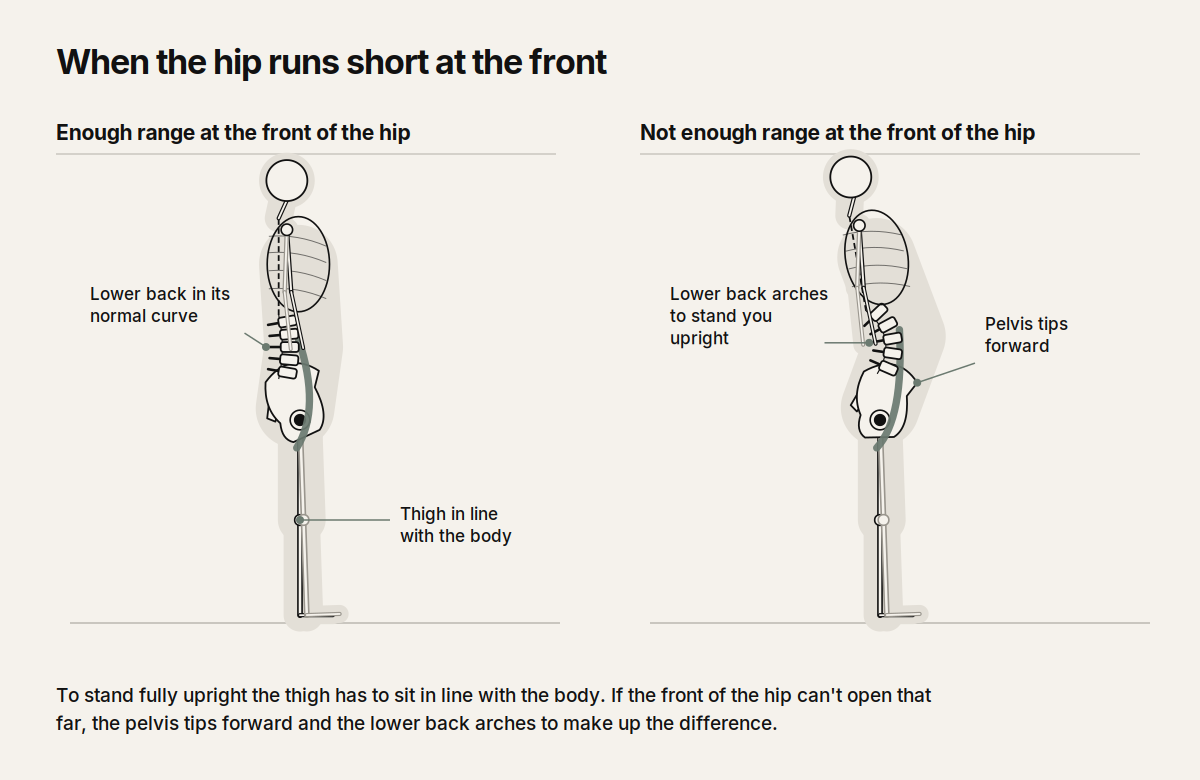
When the hip runs short, the movement still has to come from somewhere, and the lower back is next in line. Stand up with hips that won't fully open at the front and your lower back arches to get you upright. Bend down with hips that won't fold well and your lower back rounds further to make up the distance. Either way, your back is doing a share of the work your hips would normally do.
There's a second effect, and it's about the sitting itself. When you sit rounded for a long time, the ligaments at the back of your lower spine are held under a steady stretch, and they lengthen slightly under that load. That's normal behaviour for ligament. It takes a while to recover once you stand, longer than most people expect, and in that window your spine has a little less passive support than usual. That's why lifting the suitcase out of the boot straight after a three hour drive is a poor plan.
None of this depends on sitting badly. A textbook posture held for five hours is still five hours in one position.
Two checks you can run now
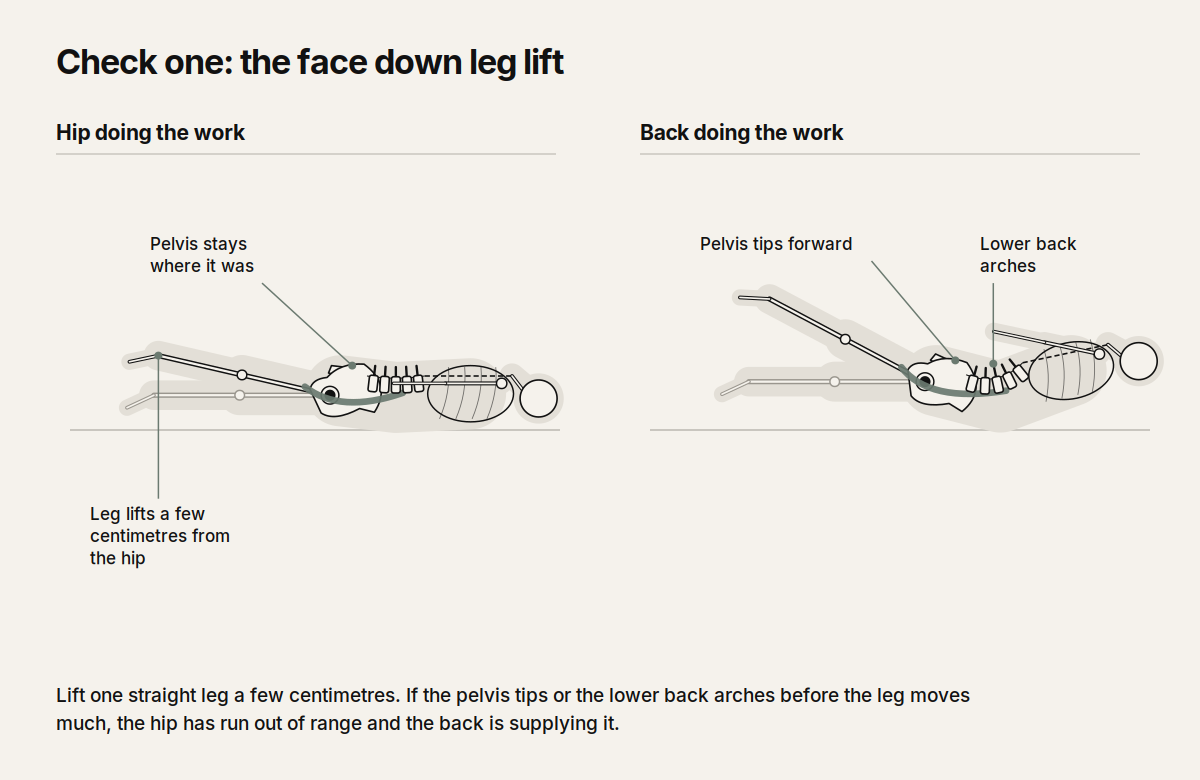
Face down. Lie on your front with your forehead on your hands. Lift your straight left leg a few centimetres off the floor. Have someone watch your lower back, or put one hand there yourself. If your back arches or your pelvis lifts on the right before the leg moves much, your hip has run out of range and your back is supplying it. Repeat on the right.
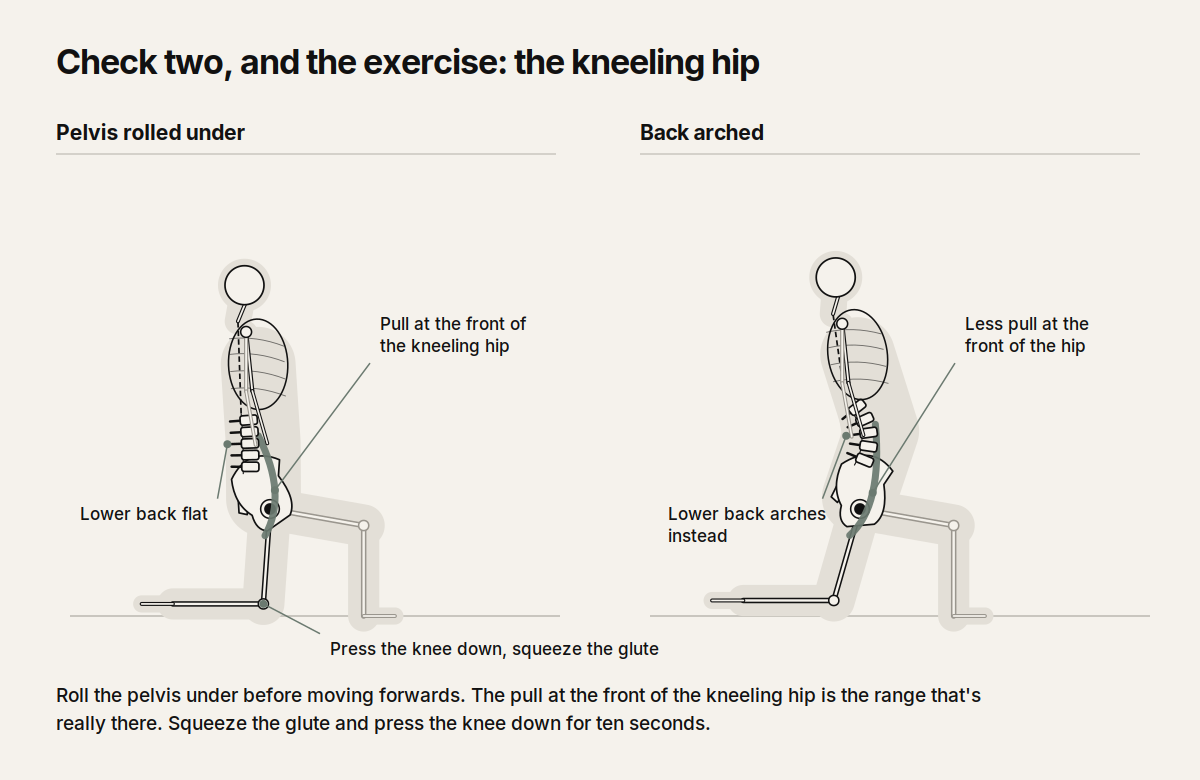
Kneeling. Kneel on your left knee with your right foot flat in front. Before moving forwards at all, roll your pelvis under so your lower back flattens. Many people feel a strong pull at the front of the left hip without having moved an inch. That's how much range is really available there. If you can only get further by arching your back, the extra isn't coming from the hip. Swap sides.
What to do about it
Load the front of the hip. Take the kneeling position above, left knee down first. Keep the pelvis rolled under, squeeze your left glute hard and press the left knee down into the floor for ten seconds. Relax, then see if you can ease forwards a little without your back arching. Five rounds, then the right side. The squeeze matters more than the forward movement. You're giving the hip force at the end of its range, which is what gives it a reason to keep the range.
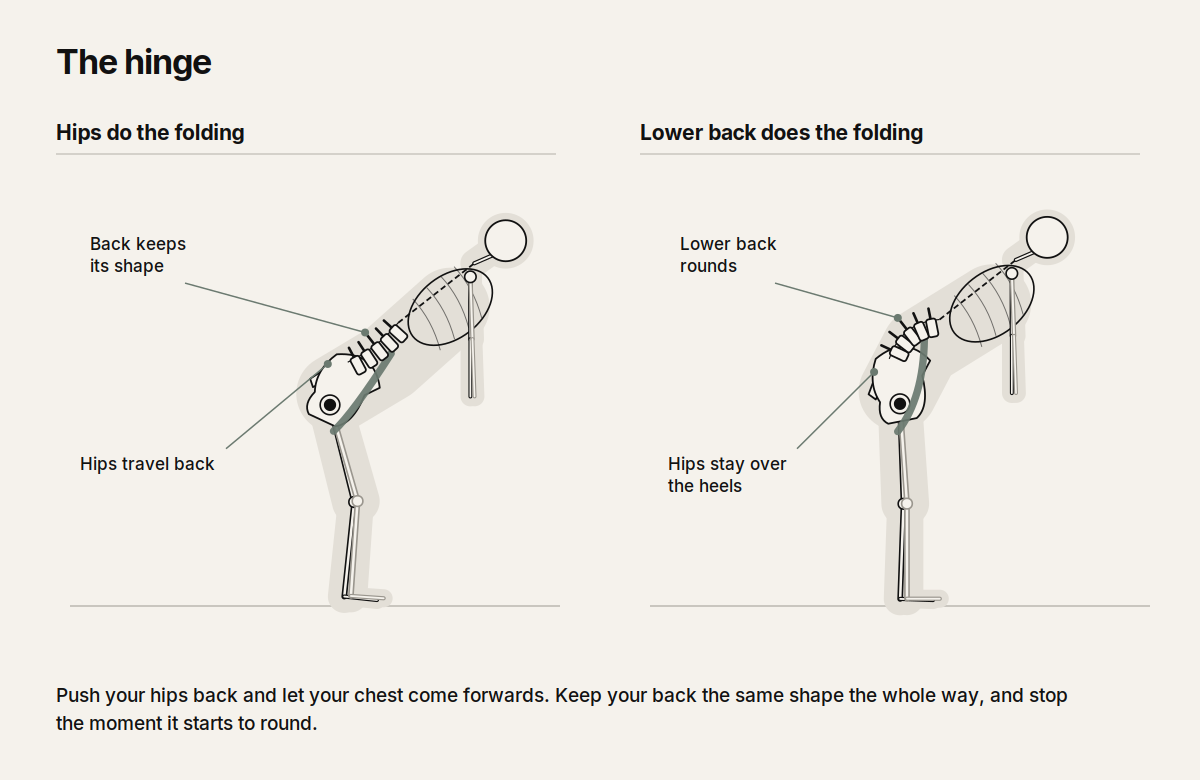
Practise the hinge. Stand with your hands on the creases at the front of your hips. Push your hips back as if closing a car door with your backside, letting your chest come forwards. Keep your back the same shape the whole way, and stop the moment it starts to round. Stand back up by driving your hips forwards. Ten slow reps. This teaches your hips to do the folding when you bend, so your lower back doesn't have to.
How often. The kneeling work once or twice a day. The hinge before anything you'd normally bend for, until it's how you bend. Then, during the day, stand up at least once an hour and take your hips through their range for a minute. Duration is the thing you're counteracting, so the answer has to be spread across the day.
After a long sit, give your back a few minutes of walking before you lift anything heavy.
The honest limit
Lower back pain has a long list of contributors; sleep, stress, how active you are overall and plain bad luck all play a part. Your back may not follow the pattern above, and a blog post can't tell you whether it does. The face down check is a reasonable first indication. A measured session is a better one.
If your pain runs down a leg, comes with numbness or pins and needles, or wakes you at night, that's a conversation with a GP or physio. Any change in bladder or bowel control alongside back pain needs same day medical attention. We don't work with injuries and we're happy to say when something is one.
“Bit early to say if it's completely fixed my back after five years of it being bad, but it didn't make it worse which I was worried about. Mark explained things really down to earth. Slept okay last night for once too.”
— Peter K.